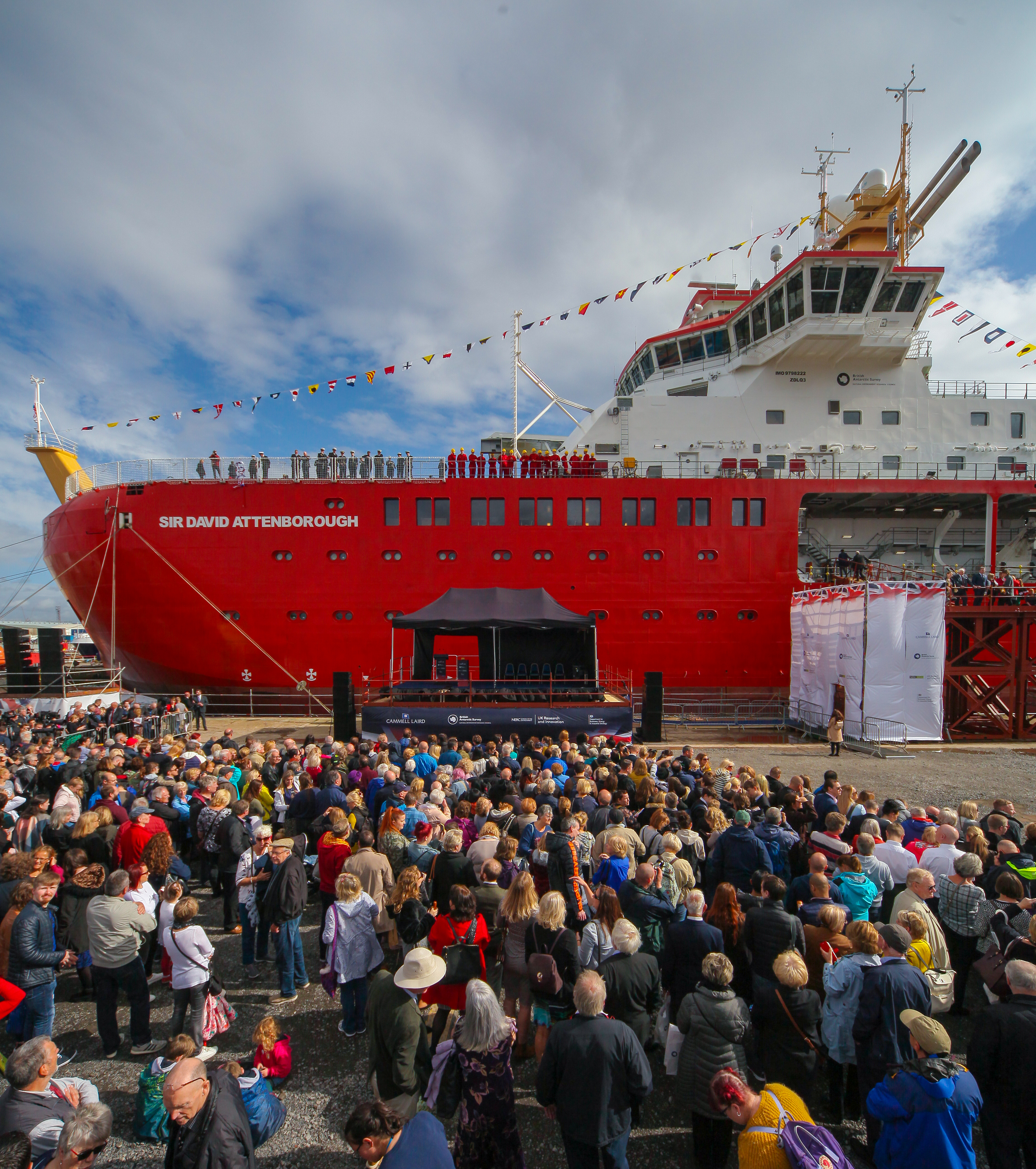
Around this time, it is worth keeping an eye on the Marine Traffic website. This shows the movement of shipping using the AIS trackers which vessels have to have switched on to plot their position.
Zoom down to the waters off the Antarctic Peninsula and you will see them start to come to life as the austral summer arrives, pack ice melts and the research vessels and tourist ships start to head south. You may also see trawlers out to catch krill, and other vessels.
See what you can spot.
There were quite a few Viking Cruise Line ships there earlier, and the BAS research vessel Sir David Attenborough.
It's time to sign up to take part in the British Antarctic Survey's 'Ticket to Antarctica' project.
We will be following with Year 8.
Here are the details:
Your name will go on a journey to the frozen wilderness!
New project seeks to inspire, educate and entertain the public about Antarctica.
Do you dream of visiting Antarctica? Well, now’s your chance to follow a journey to the frozen continent – according to the naturalist and broadcaster Sir David Attenborough.
Ticket to Antarctica invites the public to follow an adventure to Antarctica aboard the UK’s Royal Research Ship Sir David Attenborough. Last year 70 000 people signed up!
People can sign up at tickettoantarctica.co.uk to add their name to a time capsule that will travel thousands of miles on the research ship to the UK’s Rothera Research Station in Antarctica, operated by British Antarctic Survey (BAS).
As well as receiving a souvenir digital ‘ticket’ featuring campaign character Pebble Penguin, there will be weekly email updates from the voyage.
The Arctic and Antarctic are changing so rapidly that the maps need updating regularly. This work is completed by the British Antarctic Survey. I have one of their maps for my department, but perhaps need the latest now to replace it (or for comparison).
Today our cartographers released new Antarctic and Arctic maps - with lots of changes to these fast changing and fragile places:
Our King's Ely flag has made it to South Georgia and may well head further South. Well done to all those who sent in a flag design for this competition.
King's Ely Junior pupil, Lawrence Boness, is a winner in the
Schoolchildren from across the globe were invited to design flags as part of the annual Antarctica Day celebrations, which mark the fact the Antarctica Treaty was signed on December 1st, 1959.
Mr Parkinson, Head of Geography at King's Ely Junior, encouraged pupils to enter the competition and Lawrence's design, pictured here at Hope Point on the island of South Georgia, was chosen as a winner.
A spokesperson for the competition said: "The aim of this initiative is to inspire new generations about the Antarctic and Antarctica Day. The idea is that following a lesson(s) on Antarctica, students design a flag for the Antarctic – as it does not have its own – based on what they have learnt."
Well done Lawrence - how fantastic to see your design here at Hope Point!
Thursday this week saw the naming ceremony for the new British Antarctic Survey research ship, the Sir David Attenborough. It was a reminder that asking the public their opinion is a bad idea as it would have been called Boaty McBoatface if the public vote was actually followed through with.
I suggested Tom Crean for the name at the time.
A good day today, as we finally launch a resource that has been in the pipeline for over a year, and has been tweaked and improved over the last year or so. I've blogged about it here before.
Here's some text from the official press-release.
The Ice Flows teacher resources pack provides a range of resources and suggested lesson plans built around playing Ice Flows game. The learning outcomes relate to an understanding of the interactions between ice sheets and climate, and the resulting impact of changes in ice sheets on global sea level. The resources include explainer videos, some skeleton PowerPoints to use as a basis for lessons, plus added extras such as a Spotify playlist.
The resources are aimed at pupils in KS3 in UK Schools, but the main resources are generic enough to be used with any curriculum or age. We also provide information on how the game could be used in line with the UK curriculum for older pupils.
The resources were created in partnership with the Geographical Association, written by Alan Parkinson, Consultant to the Geographical Association, and Anne Le Brocq, Senior Lecturer at the University of Exeter. The game “Ice Flows” was developed by Dr. Anne Le Brocq at the University of Exeter in collaboration with Inhouse Visuals and Questionable Quality. Funding was provided by the Natural Environment Research Council (NERC) through a research grant led by the British Antarctic Survey.
The 2nd version of the website has also been launched, and we've also added a series of instructional videos which help relate the game to the science that underpins it. If you haven't seen it before (or even if you have) head over to the Ice Flows Game website to take a look.
Any feedback welcome. Thanks to students from King's Ely Junior who have helped with their feedback when playing the game, and using some of the earlier versions of the resources. Thanks also to those teachers who came along to the workshop that Anne and I ran at the GA Conference in April 2018
To work in Antarctica...
Here's a British Antarctic Survey video showing some of the careers that they offer, and the landscapes you might find yourself working in if you get a job for them.
What skills do you think you need to get a job on the 'Sir David Attenborough'?
Each national agency also has jobs at their relevant research stations: over 40 nations have bases in Antarctica.
We've been exploring the effort that goes into getting somebody down to Antarctica to work for the British Antarctic Survey (or other countries' research operations)
Antarctica has a new set of maps, created for the latest edition of the Times Atlas with data provided by the British Antarctic Survey.
They show a lot of new detail and also subglacial features, some of which are being revealed in other parts of the world as ice melts away. There are some important geographical features here.
Remember that we used the BAS website to provide live weather forecasts from locations around Antarctica.