EFL stands for Enhancing Fieldwork Learning in this event.
The EFL project team coordinates an annual Showcase event that brings together fieldwork educators from a range to disciplines to share innovations in field teaching and learning with a particular focus on the use of technology.
I last attended and spoke some years ago, talking about our work on Mission:Explore.
The 16th Enhancing Fieldwork Learning Showcase will focus on the theme of ‘Bridging the Divide’.
The free Showcase Event will be held on 8-9th September 2026.
The hybrid event will be in-person at the University of Southampton and broadcast online.
"We are pleased to confirm two Keynote speakers – Dr Nicholas Worsfold (Brunel University) and Alan Parkinson (King’s Ely Prep School / Royal Geographical Society) – who will speak about their experiences of bridging the divide from school to HE in addition to reflecting on how AI can be used most effectively in bridging digital and real world learning."
There will also be opportunities to trial innovative survey and field sensing technologies with Environmental Sensing @ Southampton: https://esas.soton.ac.uk/.
KCSIE 2026 talks extensively about mental health, contextual risk, children potentially at greater risk, absence, information sharing, online harms, professional curiosity and whole-school safeguarding. Yet it still fails to name climate change as a foreseeable, context-shaping condition already affecting children’s physical welfare, emotional wellbeing, attendance, safety, learning environments and family circumstances.
Kit has stepped in and produced an illustrated set of guidance materials for DSLs.
As I enter the 2nd week of my school holidays already, I remember that some schools still haven't finished for the summer and next week sees another run of temperatures in the high 20s and low 30s.
My last week of term featured some very hot and uncomfortable temperatures in my classroom.
The guidance that Kit has produced (all free to use under CC license) includes scenarios to consider.
A heatwave is not automatically a safeguarding concern. A flood is not automatically a safeguarding concern. A drought warning is not automatically a safeguarding concern. A pupil expressing climate worry is not automatically a safeguarding concern.
But any of these can become relevant to safeguarding when they affect a child’s welfare, visibility, attendance, behaviour, safety, access to learning, home circumstances or mental and physical health. That is the point KCSIE misses.
Climate risks are not always safeguarding concerns in themselves. They are safeguarding amplifiers. They can intensify existing vulnerabilities or make hidden ones more visible: housing insecurity, domestic stress, poverty, food and water insecurity, transport barriers, medical vulnerability, SEND-related needs, sensory distress, caring responsibilities, absence from education, poor mental health, social isolation, exposure to misinformation, and unequal access to safe outdoor space.
Kit outlines why context matters here: both home and school.
She then provides a series of scenarios with illustrations and questions. For example:
What questions and decisions need to be made here:
The practical staff model can remain very simple:
Notice the context.
Respond proportionately.
Record factually.
Refer if concerned.
Review patterns.
That is KCSIE applied with context, and not an extra burden.
These resources should find their way into many schools - particularly those which faced difficult choices in late May and through June.
Regular readers will know that I have been involved with ERASMUS projects for many years. These have included the DigitalEarth project - a huge undertaking involving meetings across Europe, the GeoCapabilities project, I-USE, D3, GI Learner and GI Pedagogy. Search the blog using the name of the project to find out more about them.
Two of these projects involved my current school, and my MFL and ICT colleagues were also involved in gaining funding for their projects as well.
As the UK’s National Agency, the British Council will work with partners across education, youth and sport to deliver inclusive, high-quality opportunities for learners and professionals from all backgrounds.
We’ll keep you updated with:
Key dates and timelines
Information on eligibility
Guidance on how to apply
Stories and examples to help you prepare
International experience builds confidence. It builds skills. It builds futures.
I'm hoping to be involved with ERASMUS projects for some years to come, and am always available to add my expertise to projects.
This is actually the first day of my summer break, so will be a nice way to end the term by picking up lots of ideas from those who are chosen to present.
Peter King, who co-ordinates geography activity for the IAPS, has moved the date of the annual geography conference to Thursday 21 May 2026. This gives more time for people to book onto the event.
It will still be held at the lovely location of Beeston Hall on the north Norfolk coast, so we can take advantage of our location in the afternoon with a session on fieldwork led by Jon Cannell (Geographical Association).
The morning session will include a talk from Alan Parkinson (that’s me)…. (author, head of geography at King’s Ely Prep and Vice President: Education of the Royal Geographical Society) who will talk about curriculum development and Peter King will plan to share some ideas that have accelerated and improved learning in the classroom.
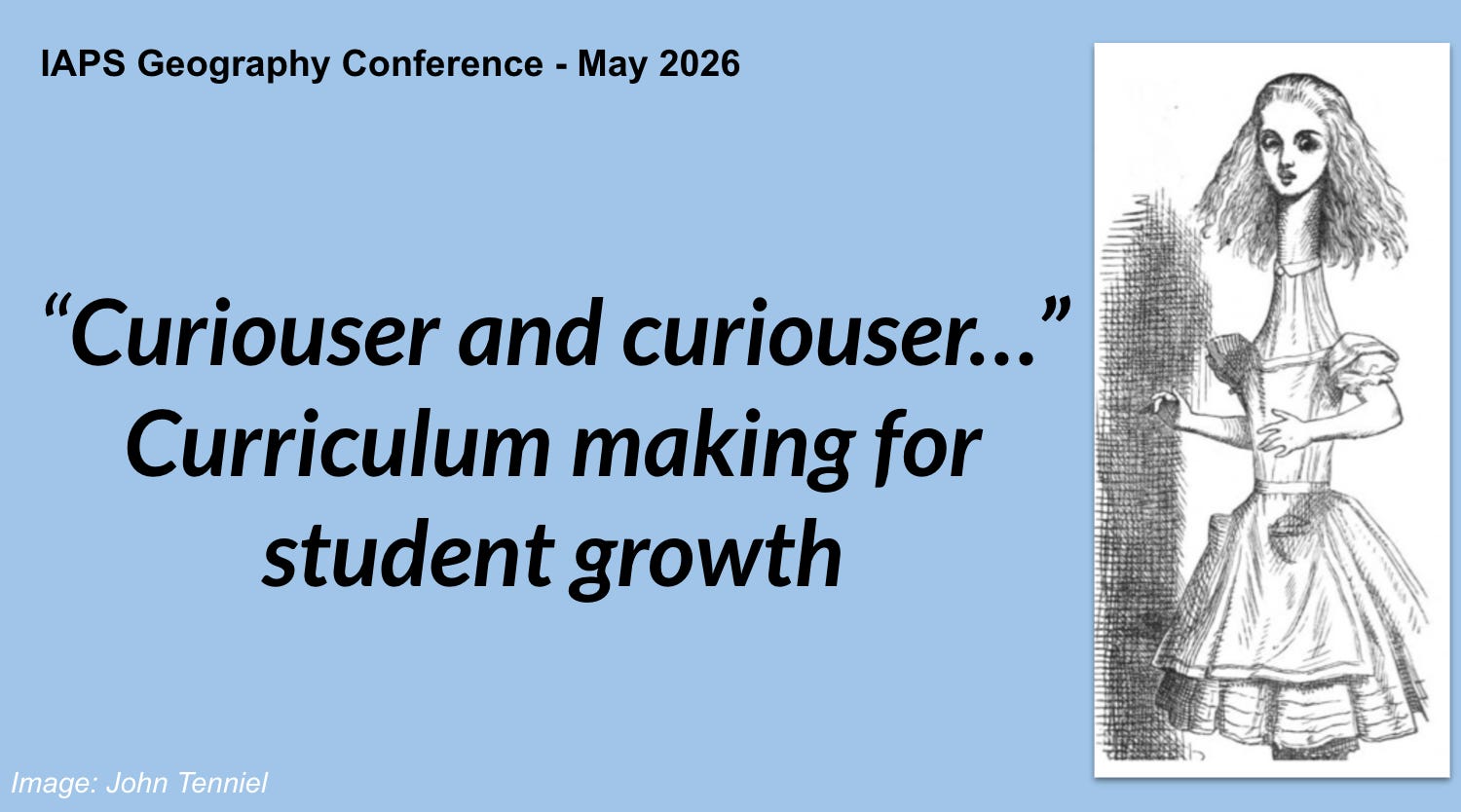
Here’s the title slide of my slide deck for my workshop. It will be modelled on my GeoLincs session from today.
We plan to kick off the day at 9.30am and finish around 4pm.
The cost of the day is £199 for IAPS members and £250 for non-member schools.
The 34th book that has been published that I have been involved in creating.
My author copy has just arrived.
It's an anthology book, pulled together by Jennifer Monk and Catherine Owen. It features a whole range of people writing about different aspects of the subject.
Introduction – why this, why now?
1. What is geography? - this is the bit that I wrote.
2. Where has geographical enquiry taken me? 3. Writing a key stage 3 geography curriculum from scratch 4. Lesson planning in geography 5. Assessment at key stage 3 6. Purposeful feedback 7. Questioning in geography 8. Where does fieldwork fit in the 11–14 geography curriculum? 9. Using homework to add breadth and depth to the curriculum 10. Incorporating geographical skills within a curriculum 11. Making GIS ‘part of the furniture’ for the teaching of geography 12. Using models in the geography classroom 13. Oracy strategies to improve geographical writing 14. Literacy in geography 15. Writing like a geographer 16. Choosing and using case studies 17. Supporting students with SEND in geography 18. Teaching ‘disadvantaged’ students 19. Retrieval practice in geography 20. Using Instagram and an iPad to engage students 21. Leading a geography department 22. Supporting geography early career teachers 23. Supporting non-specialists to teach geography 24. One approach to key stage 2 geography - Moat Farm Junior School 25. Thinking synoptically in the A-level geography classroom 26. Teaching careers in geography 27. The wonder of physical geography 28. The diagram, the visualiser and the vignette: How to teach about the multiplier effect 29. Exploring gender in the secondary geography classroom 30. Geography … is it queer? 31. Why voices matter now 32. The power of storytelling in geography: a decolonial perspective 33. What is geography teaching today as a Black British geography teacher? 34. How can we make our UK geography content less England-centric? 35. Lantinx visibility 36. Environmental Education: An integrated approach 37. Climate change, super wicked problems and antifragility 38. At and beyond the chalkface: the role of the geography teacher in the age of climate crisis 39. Who owns the Earth? Property rights and environmental conflict 40. Hopeful geography
In Chapter 1, I try to answer an important question for geographers:
My copy was published by Hachette (John Catt) in 2025
I was only due to be at the GA Conference for one day, which meant an early start for the drive over to Oxford from Norfolk. It's a real cross-country faff. Luckily I'd made some arrangements for parking which was easy enough to reach and close to the main social event of the trip.
I was there for the Long Standing members meal. This is an annual lunch which is paid for by a previous member which allows those who are going along to the conference to meet up with former Presidents of the Association and network.
Here's a picture taken at the restaurant where the meal was held. The food was delicious. There are quite a few former Presidents in the image. How many can you name?
After that, it was a taxi up to Oxford Brookes University: the conference venue.
I didn't plan to attend any sessions other than one... and I arrived too late for that one, but managed to speak to David Lambert who was presenting it.
What I really wanted to do was spend the four hours-ish I had there to catch up with as many people as possible. I managed to catch up with lots of former GA colleagues and the team that helped me when I was President, and current RGS colleagues, Primary legends such as Sharon Witt, Anthony Barlow, Stephen Scoffham and Steve Rawlinson and many more besides. Particularly nice to chat to John Wilkinson and David Balderstone, Andrew Lee and Hermione Miao.
I also met up with Tom Collins from the Environment Agency who I worked with on a forthcoming project for over a year but had never met in person, and folks from various publishers and lovely to see Cath Rule from Rayburn Tours as well.
There were at least 20 other people I chatted to, you know who you are - they include teachers, publishers and other geographers :)
After that, I got the bus back into the centre, and got off outside Christ Church College, where the GA began in 1893, and then to the Rose and Crown where I had a drink and chat with Phil from Wychwood School, who had kindly provided the parking place for me. Good to catch up and have a drink before the return journey which was going well until I found that the A47 was closed overnight... ideal...
Next year is Sheffield. I look forward to seeing what the venue is along with theme etc.
My session took place after the morning break on Day 2.
I spoke about the work we had done at King's Ely Prep to develop a new unit on Samantha Harvey's 'Orbital'.
This was still a work in progress, but has gone down well so far, and there is more to come in the final 2 weeks of this half term.
I will be blogging about this again once it has been completed, and sharing all the resources. Year 6 have been enjoying the unit I think - a questionnaire is coming up.
Thanks to Sophie Wilson for sharing some images of me in action. I was pleased with the reception to, and interest in, the talk and the project.
The Festival of Geography brings together colleagues from the Royal Geographical Society and Geographical Association (GA) for a joint celebration of geographical knowledge and understanding.
This special event is an opportunity for teachers at all stages to come together and share their passion for geography. Over a full day, attend sessions on creative and practical ideas for the classroom and get subject updates from experts in the field.
The day is bookended with sessions from the GA and RGS-IBG on the future of geography teaching and its value as a subject for students of all ages.
The festival consists of a full day of talks and workshops held live at the RGS-IBG in London on 16 June 2025.
Programme
10.00 - Welcome
10.15 - Geography: the Big Picture (Steve Brace, GA Chief Executive)
10.45 - Keynote lecture: Mark Maslin (University College London)
11.30 - Tea and coffee
11.45 - Creative curriculum ideas (Fiona Sheriff)
12.45 - Lunch
13.30 - Practical fieldwork ideas (Chloë Searl)
14.30 - Tea and coffee
14.45 - Subject knowledge sessions (Anjana Khatwa and guest)
15.45 - Choose Geography: embedding careers education into your teaching (Alan Parkinson, VP Education Royal Geographical Society)
The latest book by geography teacher Richard Bustin was published by Crown House Publishing in October 2024. It is an extension of the work carried out by Richard for his PhD, and a previous book published by Springer Nature.
Richard's PhD was based on his involvement in the work of the GeoCapabilities project.
I am proud to have been part of phase 2 of this project, which has had three phases to date. My involvement came when the project developed the ideas of curriculum making and connected it with the idea of vignette and the use of artefacts. All of these are referenced in the book.
GeoCapabilities began in 2012 with a pilot project led by the American Association of Geographers. This work is summarised in the online journal RIGEO. The first phase was funded by the AAG.
At the GA Conference in 2012, I co-presented a session on the digitalearth ERASMUS+ funded project which I had been part of - a multi-million pound project, and I helped to lead one of the sub-groups which took me to various European locations including Klagenfurt. This was with Michael Solem and John Lyon, and was an interesting experience, and led to me getting involved ultimately with Michael Solem's work.
In 2013, GeoCapabilities became an EU funded programme as a 3 year Comenius project (539079-LLP-1-2013-1-UK-COMENIUS-CMP).
GeoCapabilities is international in scope. It embraces in how geography is understood and expressed in national school standards. The capabilities approach helps geography educators everywhere to articulate the importance of children learning how to think geographically. This is part of what is called curriculum leadership.
I joined the project team, working on behalf of University College London. I also co-presented at several events with the legend that is Duncan Hawley.
In the 2nd phase I attended meetings in Sheffield, Bruges, Brussels and Helsinki.
In Brussels we discussed the way that we might share the work of teachers who we were working with the ideas we had developed. These included the idea of 'curriculum artefacts' which went along with David Lambert's previous development of 'curriculum making' as an important activity for teacher to engage in. I suggested the relatively new (at the time) technology of ESRI StoryMaps.
Richard has looked to extend the ideas from the project across the curriculum. Inevitably there are quite a few references to geography, but he also develops some thoughts on how this could be applied to other curriculum areas. There is something here for teachers of most subject areas.
Richard's book is not only about geography but attempts to apply the geocapabilities framework to all the major curriculum subjects. An introduction sets out the journey that Richard has been on since his first involvement in the project. This is an important section as it sets the scene but also outlines the development of the approach he advocates. It is research-informed but also practical in nature.
Part 1 of the book is called Theory.
It provides some wider reading and also develops some conclusions. Some of the wider reading was not to my taste when I read it, but it all counts in helping to develop a personal 'philosophy' on the complex nature of the job teachers do, and why we do what we (choose to) do.
The first section considers which knowledge is the most important, with the story of a Māori story recounting the formation of glaciers which would not be viewed as significant as the more 'scientific' explanation but nonetheless is 'a different form of truth' and helps get away from the 'single story' that some schools would have - focussing on the particular story that the awarding body wants them to tell to meet a bullet point on a specification. He moves through the previous 'Trad vs. Progressive' binary which was always unhelpful, and introduces those who are not geographers (and have probably heard David Lambert's work before) to the idea of Futures 1, 2 and 3 (alternative curriculum models).
A reference point for this is Michael Gove's 'infamous' and deluded claim from 2016 that people had 'had enough of experts' though a recent visit to a private dentist for complex root canal treatment confirmed that I'd rather have asked him than a local plumber. We need to counter the tide of fake news, which is lifted by AI and the actions of governments in more than one country... USA 2025-2028 is not a serial I am looking forward to.
As Richard says on p.22, "Teachers need to be the experts in the classroom. They need to be experts in the subjects they are teaching."
Sadly, in many schools, teacher recruitment and retention and an ageing workforce (of which I am definitely one) means that many pupils are not taught by someone who not only completed a geography degree but has also avidly maintained their knowledge of the discipline since they paraded across a stage in a gown and mortar board.
On p.29, the idea of expert knowledge is then applied to the students too. Richard talks about showing a picture of James Hutton: 'the father of modern geology" who lived in the 18th century. Which means of course he was ignorant of the basics of plate tectonics which even Year 4 students can now confidently talk about... they have more knowledge than the founding father of the entire subject. So what knowledge we teach now will retain its power during the students' life time - let alone beyond.
Geography is a rapidly changing discipline, with GIS and geospatial technology - supported by AI - developing at pace. This section also outlines differences between curriculum choices made in England, Scotland and Wales.
Chapter 4 introduces Amartya Sen and his work as a way to explore the knowledge work that Richard carefully outlines in the first 3 chapters. This is where he references and explores the work carried out in his PhD and the previous book for Springer which is very much more geography and capabilities focussed. The diagram he includes on p.67 of the book is key here.It includes the importance of agency, which is key.
He outlines some of the other thinkers who have worked in the field of capabilities in education, which is useful, and includes the curriculum making diagram which geographers will again be very familiar with (I hope). This points out the importance of teacher choices, and includes a sentence that most teachers will relate to:
"A lesson at the end of the day on a Friday afternoon might look very different to the same lesson with the same class on a Monday morning..."
Part 2 of the book is called Theory into Practice.
This is where Richard looks at other curriculum areas. Each of these is called 'What might make.... <insert subject here> a powerful knowledge?'
This returns the thinking to the idea of knowledge(s) and the implication that to unlock this requires what Margaret Roberts has called "powerful pedagogy" which is where we come in...
Richard looks at the following curriculum areas:
Mathematics
English literature and language
Science
Humanities
Creative Arts
Languages
Physical education
The final section looks at how to move towards a whole-school capabilities curriculum, which would take rather more effort but would also be the best way to ensure that the ideas gained traction. It's difficult for one subject to work in a different way to others, especially in a world of MATs and their 'corporate' nature. I teach in an Independent school currently, having spent a considerable amount of time in a state school where my creative and 'disruptive' tendencies were not always welcome.
There is no set structure that each of these chapters follow, as each subject area is so different in the established frameworks for knowledge and the chosen pedagogies. In my school, regular testing is an important element of science, and the use of gamification is common in MFL.
Each chapter looks at some previous methods of teaching the subject and explores the evolution of current established methods, which are predominantly the result of teacher choice. When I first started teaching in 1988, the Key Geography series was the choice... which meant a textbook-driven pedagogy, which was lamentable looking back, and which I talked about in my recent session at Practical Pedagogies 2024.
On pp.135-6 Richard also discusses the need to de/colonise curricula, and that the Humanities have a legacy of ignoring discussions about what was taught and how it was framed. He references Danny Dorling and Carl Lee's excellent book here, which reminds us that the word 'power' can mean lots of things: as explored by Daryl Sinclair in a recent GA session, Christine Counsell in the excellent new KS3 History scheme she is coordinating, and also Doreen Massey's work on "power geometries". We have powerful choices to make as teachers... There are some excellent suggestions for readings in this important area contained in this section, including Mark Sheehan's work on a "culturally responsive" curriculum. Read this Open Access UCL for some further Historical thinking.
The book is also in some ways a CPD handbook for a department (or even an SLT team) to use to engage with the capabilities approach. There are discussion questions at the end of each section, which could be used by teachers working together to develop their practice. This would take a while to work through, but it would be interesting to see the outcomes, particularly if the approach was taken across a whole school.
Richard has drawn on a wide range of sources and worked hard to show how the capabilities approach can work across a range of subject areas... particularly in PE... and ends with a reminder that we have the power in our own classrooms, and should be the curriculum makers. As I said when I worked for the Geographical Association and led sessions for young teachers, every teacher is a Head of Geography, because if they're not actually holding that post... they're teaching particular students rather than that person...
It is very well written, and easy to digest as Richard unpicks the threads of how we have arrived at the current position we find ourselves in. With the deadline for the 'call for evidence' for the Government's Curriculum and Assessment Review coming at the end of the week, and the next stages when subjects will be looked at in detail, this book has arrived at the perfect time for schools who want to take a fresh look at why they do what they do.
Recommended for a departmental CPD library or as a book to hand to someone who has expressed an interest in taking on extra responsibilities or particularly enjoys the act of curriculum making.
Disclosure:
My copy was a review copy provided by the publisher, but I have also purchased a copy for my department's CPD library.
This is a blog to share work around my work as Vice President:Education of the Royal Geographical Society.
The GA's Fieldwork Festival during June has ended, but fieldwork can carry on at any time of course, and we hope that your summer travels may well involve some 'fieldtrips' AKA family holidays, or personal travels. These may be in the local area or further afield.
One issue for teachers when consultations take place is to have ideas for fieldwork which are low cost (ideally free) and can be carried out in the local area. In terms of having ideas for fieldwork. The sharing of ideas in this area are particularly helpful.
The form can be used to tell us about the fieldwork that you are undertaking, and help share examples of free resources.
Have you got fieldwork resources that other teachers might find useful?
These might be resources for fieldwork in a specific location or for fieldwork activities that could be carried out anywhere.
Select the fieldwork location and upload any accompanying materials to share.
Esri and RGS will not check or verify information added here. Teachers and schools using this 'crowdsourced' information are responsible for checking accuracy and considering all aspects of health and safety before using any of the shared ideas and resources to undertake fieldwork.
The suggestions shared should only involve access to public land.
Teachers must have the right to share the materials they upload and by uploading them, teachers agree to allow others to freely make use of them to develop their own fieldwork.
No one may sell information or resources presented here.
All of the materials shared through this fieldwork ideas and resources portal are published under a CC BY-NC 4.0 licence
The latest running of the Cambridge and District GA's GeogMeet is now ready, and you can join in and hear some excellent presentations from students as in previous years. This is a model which could hopefully be adopted by other branches and local networks, giving 'A' level students agency.
The keynote speaker who will bookend the event is Hywel Roberts. He was awesome. His book 'Bothereredness' has been published since the last event, when he was sharing some of the ideas behind it, and comes highly recommended.
You can find out how to get your Early Bird ticket and also see the full programme (subject to the addition of other sessions) on the link above as well. There are over 120 sessions. They are all presented by teachers / educators, sharing what they do with colleagues. You will see session from Richard Allaway and Matt Podbury and quite a few other familiar names here.
My session is here, as described. It will take place on the 1st day of the conference.
Why not join me in late June for the latest RGS-IBG Teachmeet - once again, it's online rather than face to face, but that allows people to join who would not be able to get to Kensington on a weekday evening, so that's fair enough.
Jo Clarke, Queen Anne's School – Using audio and visual feedback
Guy Paxman, Durham University - The Greenland StoryMap series
Jen Monk, Stretford High School – Windows and Mirrors, ensuring diversity in our curriculum
Fiona Sheriff, Kingsthorpe College - Beautiful books to inspire curiosity in the classroom
Rosie Moore, Cronton Sixth Form College - Embedding Cornell note-taking to improve assessment outcomes
Alan Parkinson, King's Ely Prep - 'Should I stay or should I go': leveraging professional support for pedagogical longevity
I'll be speaking about pedagogical longevity, and how we can use the available support from professional organisations - including the GA and RGS-IBG - to provide the spark which will get us through those times when we question whether we can stay in the classroom.
Looking forward to heading there and speaking about my pedagogical longevity and how to avoid teaching the same year lots of times. There'll be plenty of links to current projects as well.
The keynote speaker who will bookend the event is Hywel Roberts. He was awesome. His book 'Bothereredness' has been published since the last event, when he was sharing some of the ideas behind it, and comes highly recommended.
You can find out how to get your Early Bird ticket and also see the full programme (subject to the addition of other sessions) on the link above as well. There are over 120 sessions. They are all presented by teachers / educators, sharing what they do with colleagues. You will see session from Richard Allaway and Matt Podbury and quite a few other familiar names here.
My session is here, as described. It will take place on the 1st day of the conference.
One of the best events I've attended and presented at has been the Practical Pedagogies events that were held in 2016 and 2018. The first was held in Toulouse and the second was in Cologne.
Russel Tarr is now organising a third running of the event and the call for sessions is now open. I shall definitely be there (assuming my presentation is accepted). I'll be working on this over the weekend.
Workshop proposals for Practical Pedagogies 2024 are warmly welcomed from primary, secondary and whole-school practitioners and educators willing to share their expertise and practices in a friendly, collaborative, international setting.
Experienced and first-time presenters are equally welcome to submit a proposal! The special ticket price for workshop leaders is just 75 Euros for the full two days (payable upon the session proposal being accepted onto the programme). This non-refundable fee, which represents a 75% discount on the standard ticket price, helps ensure that people accepted to run workshops seriously plan to attend.
This sum is effectively reimbursed with free access to the coach which brings attendees to and from the venue from central Cologne, and complimentary meal at the evening restaurant function on the final evening, which is always a highlight of the event. However, please note that in order to keep delegate ticket prices genuinely affordable, we are not able to cover any other expenses.
I've been involved with the OS in numerous ways over the years: as a GetOutside Champion, author of support resources for Digimap for Schools and Digimap for Colleges / Mapstream. Also as an author of articles for Mapping News and other support for various campaigns and activities.
For many years Ordnance Survey has delivered support for education to encourage the awareness and use of high-quality geospatial data in the education sector and since 2020 this has been through an Education Plan, funded through the UK Government's Geospatial Commission (GC). They are keen to gather evidence about how this has so far supported the work of teachers and consider what more they could be doing in this area.
They would also like to understand what other training tools geography teachers currently access and the barriers that may be in place when using geographic information systems (GIS).
They are asking for 15 minutes (or so) of your time to complete a short survey.
The survey is open to all geography teachers until Friday 8 December and the findings from it will help them to consider how to develop the Education Plan.
I'm delighted to be part of the Geography SW team - collating a half termly Primary newsletter - the next issue of which will be out next week. The team also put on an excellent annual conference at the University of the West of England in Bristol, as well as providing newsletters, resources and plenty of inspiration.
SW Geography Conference 2024 . . . next year's conference has now been confirmed as Monday 17 June 2024 at UWE. Join us for this free CPD event of lectures, workshops and exhibitions. Please spread the word. Registration details to follow in the spring. https://t.co/h8ct9WQmcypic.twitter.com/dNswvWk5OU