A new book was added to the library of books made freely available by UCL Press at the end of last week. The books are available on the UCL Press website, and JSTOR.
The latest books is about bringing powerful knowledge into the classroom.
The geography chapter has been written by Dr. Alex Standish. It explores the curriculum thinking of two heads of department, who consider how knowledge is explored in their classrooms.
In July 2024, the government commissioned Professor Becky Francis CBE to convene and chair a panel of experts to conduct the Curriculum and Assessment Review.
The report has taken on board the many consultation responses from individuals and organisations.
These are available in a summary document which is separate to the main final report - this is also worth looking at.
The report has been almost a year in the making, and runs to 197 pages.
The recommendations for Geography are as follows:
We recommend that the Government:
Makes minor refinements to the Geography Programmes of Study and GCSE
subject content to respond to the issues identified, including by:
• Refining content to support progression better to further study, deepen
children and young people’s understanding of key geographical concepts,
make content more relevant and inclusive, and remove unnecessary
repetition across topics.
• Embedding disciplinary knowledge more explicitly at Key Stage 3, such as
geographical enquiry, spatial reasoning, use of digital tools, human geography and use of evidence, to ensure all children and young people
have access to high-quality geographical education.
• Clarifying and reinforcing requirements for fieldwork to demonstrate its role
more effectively in supporting content and the developing of disciplinary
knowledge, ensuring changes remain proportionate and inclusive.
Embeds climate change and sustainability more explicitly across different key
stages, including across the physical geography, geographical applications and
human geography sections of the curriculum, ensuring early, coherent, and
more detailed engagement with climate education. This should be done without
risking curriculum overload.
There is also an element of media literacy here for climate change education in particular, where there is a lot of misinformation and disinformation. There is a need for pupils to be aware of AI and its value and issues.
There is also mention of the need for diversity and for all students to "see themselves in the curriculum" - something which I was particularly keen to see.
And these will ultimately form part of changes to the national curriculum (will this be compulsory for all schools?) and GCSE subject criteria. These will be consulted on again and no changes will happen before 2028 in any case.
On the purpose of the review itself:
National curriculum content must be kept up to date, fit for purpose and reflective of the
needs of wider society. Periodic holistic reviews of the national curriculum are therefore
essential for ensuring these aims are achieved, as well as for maintaining overall
curriculum coherence. Reviews are also a valuable mechanism for addressing curriculum
shape in the round. Reviews can evaluate whether the breadth and depth of different
subjects and their content remains appropriate, as well as determining the overarching
aims of schooling and the time needed for the different activities required to meet these
aims. Reviews can also address the build-up of content in particular areas to ensure that
the curriculum remains deliverable for teachers and ambitious for students.
The Oak National Academy is also mentioned as being further involved in the development of curriculum materials which are up to date.
We agree with the Review that the national curriculum and the resources that support it,
should reflect our modern society and diverse communities. Our aim is for the curriculum
to be both a mirror, in which every child can see themselves and their communities
reflected, and a window through which every child is connected to the world beyond their
existing horizons and perspectives
On the topic of GCSE Natural History
Equipping children and young people to thrive in a rapidly changing world therefore means enabling them to understand and meet the global challenge that climate change presents. We will take the opportunity to enhance the climate education content which is already present in the national curriculum, in the subjects of geography, science and citizenship. We will also include sustainability within the design and technology (D&T) programme of study and sustainable practices within the citizenship primary curriculum. We agree with the Review that key concepts on climate education should be introduced earlier in the curriculum and will ensure that the relevant programmes of study contain this at primary level. We also want to go further on this and ensure that more people can engage with and develop respect for the natural world.
We will therefore consult on the subject content for the natural history GCSE, as confirmed earlier this year.
The Review noted that changes to curriculum content are only part of the picture and that teaching also has an important part to play through the use of climate-related examples and resources to teach existing curriculum content. The National Education Nature Park, funded by DfE, has a website which hosts free resources and activities for all education phases across a wide range of subjects. These are aligned to the curriculum and quality assured by experts, giving educators trusted information that allows them to teach about sustainability and climate change with confidence, in subjects where climate education is a core part of the curriculum content and in other subjects.
On the topic of Geography
We agree with the Review that the subject does not need significant change, and we will update and refine the programme of study and GCSE subject content with modest changes, to support pupils and teachers. As recommended, changes will support a better understanding of the disciplinary requirements in the national curriculum and in the GCSE, ensure the content is updated where needed, including in relation to climate education, and clarify and integrate the fieldwork requirements. We will also improve the GCSE subject content to support better progression, deepen understanding and remove unnecessary repetition across topics.
Some videos have also been produced on LinkedIn featuring Becky Francis.
"We will follow
the curriculum principles of coherence, subject mastery and depth – making sure
that programmes of study and subject content are grounded in relevant and
important knowledge and disciplinary skills."
A document with some notes I put together today has been shared on Scribd. See the bottom of the post.
There will also be a fully digital and easily navigable version of the national curriculum
- we will create a rich, connected online version of the curriculum which visually
represents the links within and between subject areas and gives connections to
prior learning, helping teachers to contextualise learning across traditional subject
boundaries in the classroom.
Some final initial thoughts:
When a long-awaited Government document such as this appears there will be lots of different perspectives on it: from teachers to senior leaders, to those working in Trusts (who will need to adapt what they teach).
As the Review recommends, we intend to retain a single national curriculum which
serves as a core entitlement which every pupil can access. We are legislating through
the Children’s Wellbeing and Schools Bill so that academies will be required to
teach the refreshed national curriculum alongside maintained schools. This will
ensure that parents and carers have certainty over the core concepts in their child’s
education and that there is a floor beneath which this cannot slip. The national curriculum is not the entire curriculum but an underpinning of what every child is entitled to know,
which schools build on locally. Schools will continue to remain responsible for deciding
how their school curriculum brings those core concepts to life in their choices of historical
events, physical and human geography, and novels, for example. This will allow them to
create dynamic learning environments where pupils can flourish.
From those who feel too much has changed to those who don't think the changes have gone long enough.
Some involved in climate change education will be pleased to see it referenced several times, others will feel it doesn't go far enough.
Some commentators e.g. the Daily Mail will see it's mentions of diversity, social justice and students 'seeing themselves in the curriculum' as lacking the 'rigour' that was promised in the previous iteration.
Some will say that achieving the aims for some will be possible, but not perhaps 'for all'?
Some will ask where the money is coming from.
Some will focus on the assessment element of the review and question
Some will delve into the data that was included in the review and question some of the findings.
Some will be interested in the wording of "nature and adventure".
Some will ask about the continuing lack of take-up for GIS despite the availability of free tools such as ArcGIS and its related apps.
Some will be thinking about the place of AI in this...
Some will be considering the powerful pedagogies (echoing the work of Margaret Roberts) that are required to turn the words on the page of new documentation into the enacted curriculum. I've written about that before.
"Music excites when it is performed" - Benjamin Britten
Some will say nothing today as there is much to emerge over the next two years ahead of any impact in schools.
Some will wonder about the impact on option numbers and job security, or the state of the teaching workforce.
Some will not know any of this is happening because they're getting on with the day job... and that's fine...
Roblox is a very popular game. For several years, Helen Young has been working with the BBC and several companies to produce some immersive geographical experiences based on the game engine to add to BBC Bitesize's offerings for students.
Details were published here of the results of all that work.
Planet Planners on Roblox is a new geography game from BBC Bitesize delivering learning mapped to the KS3 geography curriculum (and equivalent) in an immersive and engaging way.
Planet Planners on Roblox offers a new way for students aged 11-14 to learn about some of the world’s most pressing challenges – from preparing for natural disasters to managing large cities.
A decision-making game with geographical thinking at its core, Planet Planners on Roblox develops essential skills like teamwork, time management, resilience, critical thinking and strategic planning as well as an understanding of human and physical geography.
It is accessed via Roblox – an immersive platform for 3D experiences.
Weather and climate: Extreme weather | Low-income country (LIC) climate change [Coming autumn 2025] Population and migration: Increasing immigration | Dealing with emigration [Coming autumn 2025] Food and water: Producing food | Conserving water [Coming autumn 2025]
I had a play earlier with the coastal erosion scenario.
You're dropped into a coastal village which is very nicely created. Here's just part of it...
You have to chat to NPCs and make decisions based around a budget and decide whether to act immediately or wait...
Here's my feedback for my first attempt, where I lost a bit of time due to unfamiliarity with how Roblox works... I didn't do too badly on my scores and made some reasonable choices, but unfortunately ran out of budget...
I can of course go back and play it again to try to improve my score - and spend a little less.
The latest book by geography teacher Richard Bustin was published by Crown House Publishing in October 2024. It is an extension of the work carried out by Richard for his PhD, and a previous book published by Springer Nature.
Richard's PhD was based on his involvement in the work of the GeoCapabilities project.
I am proud to have been part of phase 2 of this project, which has had three phases to date. My involvement came when the project developed the ideas of curriculum making and connected it with the idea of vignette and the use of artefacts. All of these are referenced in the book.
GeoCapabilities began in 2012 with a pilot project led by the American Association of Geographers. This work is summarised in the online journal RIGEO. The first phase was funded by the AAG.
At the GA Conference in 2012, I co-presented a session on the digitalearth ERASMUS+ funded project which I had been part of - a multi-million pound project, and I helped to lead one of the sub-groups which took me to various European locations including Klagenfurt. This was with Michael Solem and John Lyon, and was an interesting experience, and led to me getting involved ultimately with Michael Solem's work.
In 2013, GeoCapabilities became an EU funded programme as a 3 year Comenius project (539079-LLP-1-2013-1-UK-COMENIUS-CMP).
GeoCapabilities is international in scope. It embraces in how geography is understood and expressed in national school standards. The capabilities approach helps geography educators everywhere to articulate the importance of children learning how to think geographically. This is part of what is called curriculum leadership.
I joined the project team, working on behalf of University College London. I also co-presented at several events with the legend that is Duncan Hawley.
In the 2nd phase I attended meetings in Sheffield, Bruges, Brussels and Helsinki.
In Brussels we discussed the way that we might share the work of teachers who we were working with the ideas we had developed. These included the idea of 'curriculum artefacts' which went along with David Lambert's previous development of 'curriculum making' as an important activity for teacher to engage in. I suggested the relatively new (at the time) technology of ESRI StoryMaps.
Richard has looked to extend the ideas from the project across the curriculum. Inevitably there are quite a few references to geography, but he also develops some thoughts on how this could be applied to other curriculum areas. There is something here for teachers of most subject areas.
Richard's book is not only about geography but attempts to apply the geocapabilities framework to all the major curriculum subjects. An introduction sets out the journey that Richard has been on since his first involvement in the project. This is an important section as it sets the scene but also outlines the development of the approach he advocates. It is research-informed but also practical in nature.
Part 1 of the book is called Theory.
It provides some wider reading and also develops some conclusions. Some of the wider reading was not to my taste when I read it, but it all counts in helping to develop a personal 'philosophy' on the complex nature of the job teachers do, and why we do what we (choose to) do.
The first section considers which knowledge is the most important, with the story of a Māori story recounting the formation of glaciers which would not be viewed as significant as the more 'scientific' explanation but nonetheless is 'a different form of truth' and helps get away from the 'single story' that some schools would have - focussing on the particular story that the awarding body wants them to tell to meet a bullet point on a specification. He moves through the previous 'Trad vs. Progressive' binary which was always unhelpful, and introduces those who are not geographers (and have probably heard David Lambert's work before) to the idea of Futures 1, 2 and 3 (alternative curriculum models).
A reference point for this is Michael Gove's 'infamous' and deluded claim from 2016 that people had 'had enough of experts' though a recent visit to a private dentist for complex root canal treatment confirmed that I'd rather have asked him than a local plumber. We need to counter the tide of fake news, which is lifted by AI and the actions of governments in more than one country... USA 2025-2028 is not a serial I am looking forward to.
As Richard says on p.22, "Teachers need to be the experts in the classroom. They need to be experts in the subjects they are teaching."
Sadly, in many schools, teacher recruitment and retention and an ageing workforce (of which I am definitely one) means that many pupils are not taught by someone who not only completed a geography degree but has also avidly maintained their knowledge of the discipline since they paraded across a stage in a gown and mortar board.
On p.29, the idea of expert knowledge is then applied to the students too. Richard talks about showing a picture of James Hutton: 'the father of modern geology" who lived in the 18th century. Which means of course he was ignorant of the basics of plate tectonics which even Year 4 students can now confidently talk about... they have more knowledge than the founding father of the entire subject. So what knowledge we teach now will retain its power during the students' life time - let alone beyond.
Geography is a rapidly changing discipline, with GIS and geospatial technology - supported by AI - developing at pace. This section also outlines differences between curriculum choices made in England, Scotland and Wales.
Chapter 4 introduces Amartya Sen and his work as a way to explore the knowledge work that Richard carefully outlines in the first 3 chapters. This is where he references and explores the work carried out in his PhD and the previous book for Springer which is very much more geography and capabilities focussed. The diagram he includes on p.67 of the book is key here.It includes the importance of agency, which is key.
He outlines some of the other thinkers who have worked in the field of capabilities in education, which is useful, and includes the curriculum making diagram which geographers will again be very familiar with (I hope). This points out the importance of teacher choices, and includes a sentence that most teachers will relate to:
"A lesson at the end of the day on a Friday afternoon might look very different to the same lesson with the same class on a Monday morning..."
Part 2 of the book is called Theory into Practice.
This is where Richard looks at other curriculum areas. Each of these is called 'What might make.... <insert subject here> a powerful knowledge?'
This returns the thinking to the idea of knowledge(s) and the implication that to unlock this requires what Margaret Roberts has called "powerful pedagogy" which is where we come in...
Richard looks at the following curriculum areas:
Mathematics
English literature and language
Science
Humanities
Creative Arts
Languages
Physical education
The final section looks at how to move towards a whole-school capabilities curriculum, which would take rather more effort but would also be the best way to ensure that the ideas gained traction. It's difficult for one subject to work in a different way to others, especially in a world of MATs and their 'corporate' nature. I teach in an Independent school currently, having spent a considerable amount of time in a state school where my creative and 'disruptive' tendencies were not always welcome.
There is no set structure that each of these chapters follow, as each subject area is so different in the established frameworks for knowledge and the chosen pedagogies. In my school, regular testing is an important element of science, and the use of gamification is common in MFL.
Each chapter looks at some previous methods of teaching the subject and explores the evolution of current established methods, which are predominantly the result of teacher choice. When I first started teaching in 1988, the Key Geography series was the choice... which meant a textbook-driven pedagogy, which was lamentable looking back, and which I talked about in my recent session at Practical Pedagogies 2024.
On pp.135-6 Richard also discusses the need to de/colonise curricula, and that the Humanities have a legacy of ignoring discussions about what was taught and how it was framed. He references Danny Dorling and Carl Lee's excellent book here, which reminds us that the word 'power' can mean lots of things: as explored by Daryl Sinclair in a recent GA session, Christine Counsell in the excellent new KS3 History scheme she is coordinating, and also Doreen Massey's work on "power geometries". We have powerful choices to make as teachers... There are some excellent suggestions for readings in this important area contained in this section, including Mark Sheehan's work on a "culturally responsive" curriculum. Read this Open Access UCL for some further Historical thinking.
The book is also in some ways a CPD handbook for a department (or even an SLT team) to use to engage with the capabilities approach. There are discussion questions at the end of each section, which could be used by teachers working together to develop their practice. This would take a while to work through, but it would be interesting to see the outcomes, particularly if the approach was taken across a whole school.
Richard has drawn on a wide range of sources and worked hard to show how the capabilities approach can work across a range of subject areas... particularly in PE... and ends with a reminder that we have the power in our own classrooms, and should be the curriculum makers. As I said when I worked for the Geographical Association and led sessions for young teachers, every teacher is a Head of Geography, because if they're not actually holding that post... they're teaching particular students rather than that person...
It is very well written, and easy to digest as Richard unpicks the threads of how we have arrived at the current position we find ourselves in. With the deadline for the 'call for evidence' for the Government's Curriculum and Assessment Review coming at the end of the week, and the next stages when subjects will be looked at in detail, this book has arrived at the perfect time for schools who want to take a fresh look at why they do what they do.
Recommended for a departmental CPD library or as a book to hand to someone who has expressed an interest in taking on extra responsibilities or particularly enjoys the act of curriculum making.
Disclosure:
My copy was a review copy provided by the publisher, but I have also purchased a copy for my department's CPD library.
Why not join me in late June for the latest RGS-IBG Teachmeet - once again, it's online rather than face to face, but that allows people to join who would not be able to get to Kensington on a weekday evening, so that's fair enough.
Jo Clarke, Queen Anne's School – Using audio and visual feedback
Guy Paxman, Durham University - The Greenland StoryMap series
Jen Monk, Stretford High School – Windows and Mirrors, ensuring diversity in our curriculum
Fiona Sheriff, Kingsthorpe College - Beautiful books to inspire curiosity in the classroom
Rosie Moore, Cronton Sixth Form College - Embedding Cornell note-taking to improve assessment outcomes
Alan Parkinson, King's Ely Prep - 'Should I stay or should I go': leveraging professional support for pedagogical longevity
I'll be speaking about pedagogical longevity, and how we can use the available support from professional organisations - including the GA and RGS-IBG - to provide the spark which will get us through those times when we question whether we can stay in the classroom.
I was sorry to hear of the passing of Sir. Tim Brighouse.
I had the pleasure of crossing paths with him a few times during my time working for the Geographical Association, and also in my freelance years. This list has been appearing on social media a lot today...
Here are the details of how to get a copy of a new resource which I have been working on for quite a while - since before COVID19 in fact.
After three or four drafts, the final version 1.0 is available.
It is connected with a local logistics company based in Cambridgeshire called Buffaload.
Just prior to COVID19, Buffaload CEO Ross Taylor and other colleagues met with myself and other teaching colleagues at King's Ely to talk about the school's involvement in an event that was planned to take place in Ely Cathedral, from memory to coincide with the installation of one of Luke Jerram's GAIA pieces. There was to have been some exciting elements of the event.
The company aims to become carbon neutral, and has already led the way on the use of technology in this area including the use of double decker trailer which reduce the overall number of deliveries that are needed. They work with supermarkets such as Tesco and Co-op and also deliver for local companies such as G's Fresh.
They have a real interest in the environment and are working towards becoming carbon neutral across their extensive operations, which requires quite a lot of coordinated activity and the application of different methods of working.
We explored a number of contexts related to their work and I saw the potential for a resource on their work. I had already worked on a logistics resource some years earlier. This was a major resource produced in association with the Chartered Institute of Logistics and Transport.
The new resource has a focus on the operations of Buffaload - an authentic context compared to the previous activity (see Lesson 2 Road Haulage in the CILT resource) which was based on a fictional company named after a former teaching colleague - although actually I'm really pleased with this particular activity as it happens.
There are a few accompanying resources here as well:
If you do use any part of the resource, or have any feedback on them, or suggestions for improvement, please get in touch by comment, or through the usual methods e.g. Twitter DM.
This blog has been a bit of a slow-burner compared to LivingGeography. I started it around nine years ago now, when I was about to start a new adventure in the classroom, and didn't expect that I would still be working at King's, as Head of Geography in the Junior section of the school.
It's had up around 80 000 views, which is OK.
Thanks for reading.
Image: Sundial on Ely Cathedral - Alan Parkinson, shared under CC license.
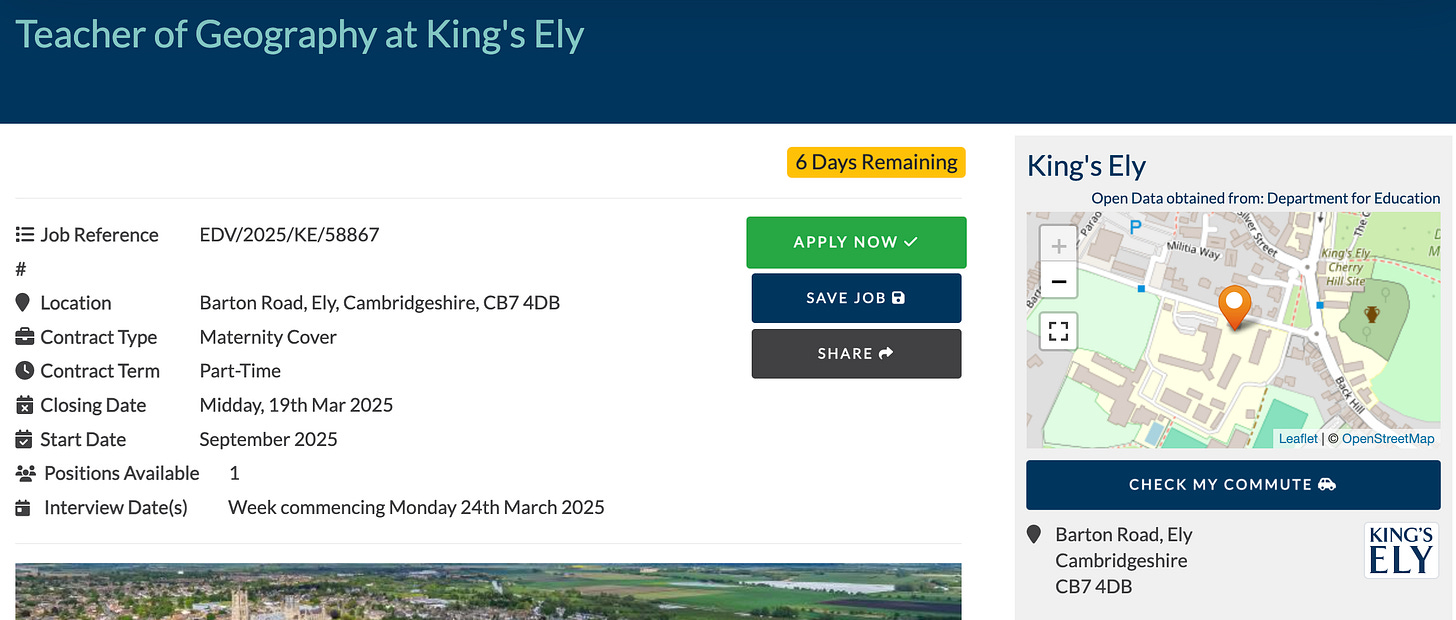
Following the interviews for the Senior school Head of Geography post at the school where I work before Easter, we now have an opening for a Teacher of Geography at King's Ely.
Greetings to those who have come via LivingGeography, which will remain my main blog.
As you may have read there, I'm going to be back in the classroom from September 2013 for a second teaching 'career'. I'll be teaching Geography (of course) and be sharing some of my planning, thinking and thoughts here, as well as student work (with permission)
This will be a classroom-focussed blog compared with my others, and also focussed on KS3 for the most part.
I'm going to have access to a set of iPads so there'll be a bit of app-related / mobile learning related content too.
I've already started planning the units I'm going to be teaching, so expect some additions here between now and September when the action starts for real.