Showing posts with label Mountains. Show all posts

Wednesday, 13 May 2026

Ropes have reached the summit

Thanks to Seven Summit Treks for their updates from the efforts to fix the ropes for the climbers this 2026 Climbing Season.

Here's a picture they posted on Facebook earlier showing the first Sherpa teams (and climbers) on the roof of the world. 
We shall be following over the next few weeks...

Image thanks to Seven Summits Treks on Facebook.

Good luck to all those pushing for the summit over the coming weeks, and the teams supporting them along the way.

Tuesday, 12 May 2026

"Once there was a mountain called Peak XV...."

Public Service Broadcasting telling the story of the expedition that conquered the mountain for the first time...

And here's the StoryMap that we used - which used to be hosted by National Geographic.

Monday, 22 July 2024

Clearing up Everest

When we teach about extreme environments, we always include a short look at Mount Everest and what draws people to risk their lives climbing it. 

We discuss the mortality rate of climbers, and the disproportionate impact on the Sherpa who fix the ropes and ladders in the most dangerous area of the mountain: the Khumbu Glacier's icefall.

There is a growing number of permits being allocated in each climbing season, which adds to the overcrowding on the mountain - the delays this leads to can increase the risk to climbers, as they may have to spend longer in the 'death zone'.

Students always ask why they don't just remove the bodies from the mountain.

The BBC News published an article on their website which goes a long way to answering that question with some specifics about the cost, the process and the risks involved.

Sunday, 26 May 2019

Queues on Everest

We have been exploring this with Year 8 this half term.


This image has been shared many times over the last few days, showing a queue of climbers attempting to reach the summit of Everest on a sunny summit opportunity. I shall talk about the image later.

There were several climbers who died as a result of this queue, and over a dozen have died in the last week or so. This has been a deadly climbing season.

Yesterday, it was announced that a UK climber has also sadly died.

The weather during this climbing season has been quite bad, partly as a result of a cyclone which hit India. This means that the 'good' days see hundreds of climbers trying to achieve their ambition of standing on the highest point on the planet. I've read many books over the years about the mountain, and seen many films and other media. I've followed the tweets and Facebook updates of fellow OS GetOutside Champion Kenton Cool, and Ben Fogle as they climbed Everest last year.

The Guardian has further reporting on the story.

A story from 2017 in similar vein shows that this is not a new story of course. Since the resurgence of climbs on Everest in the 1970s and 1980s there have been tragedies, often well below the Death Zone. I have used a range of resources to teach this topic.
A lot of my work has been framed by the work of Matt Podbury, who has produced an excellent set of materials on the mountain in his 8850 Unit on GeographyPods.

The image has been shared widely, often without credit. It was taken by Nirmal Purja Magar or 'Nims'
He is profiled here in National Geographic.

He has been part of Project Possible, which has been breaking records for climbing some of the most challenging peaks in the world in record time and hoping to continue during the current climbing season.


I also used a Tweet by Ben Fogle, and some of the responses to that tweet

Today in the Observer, there is an excellent piece on some further thoughts on this 

And a few Dark Tourism Twitter accounts have made a link to this area of study which I am going to explore next year with my Year 8 groups. I've got some excellent resources to use as a basis, and am going to

And to finish, another reminder of the excellence of Public Service Broadcasting.


Update....

Listen to this interview on the Death Zone and queues as well...


Sunday, 19 May 2019

Extreme Geographies

Having spent quite a long time exploring some issues with landscapes, our current unit is called Extreme Geographies.
It's quite short, as the summer term is mercifully short following the longer Lent Term.
It starts with a look at some of the Extreme Places
What about Mt. Everest?
How do people die on the mountain?

Deaths on Mount Everest

From Visually.

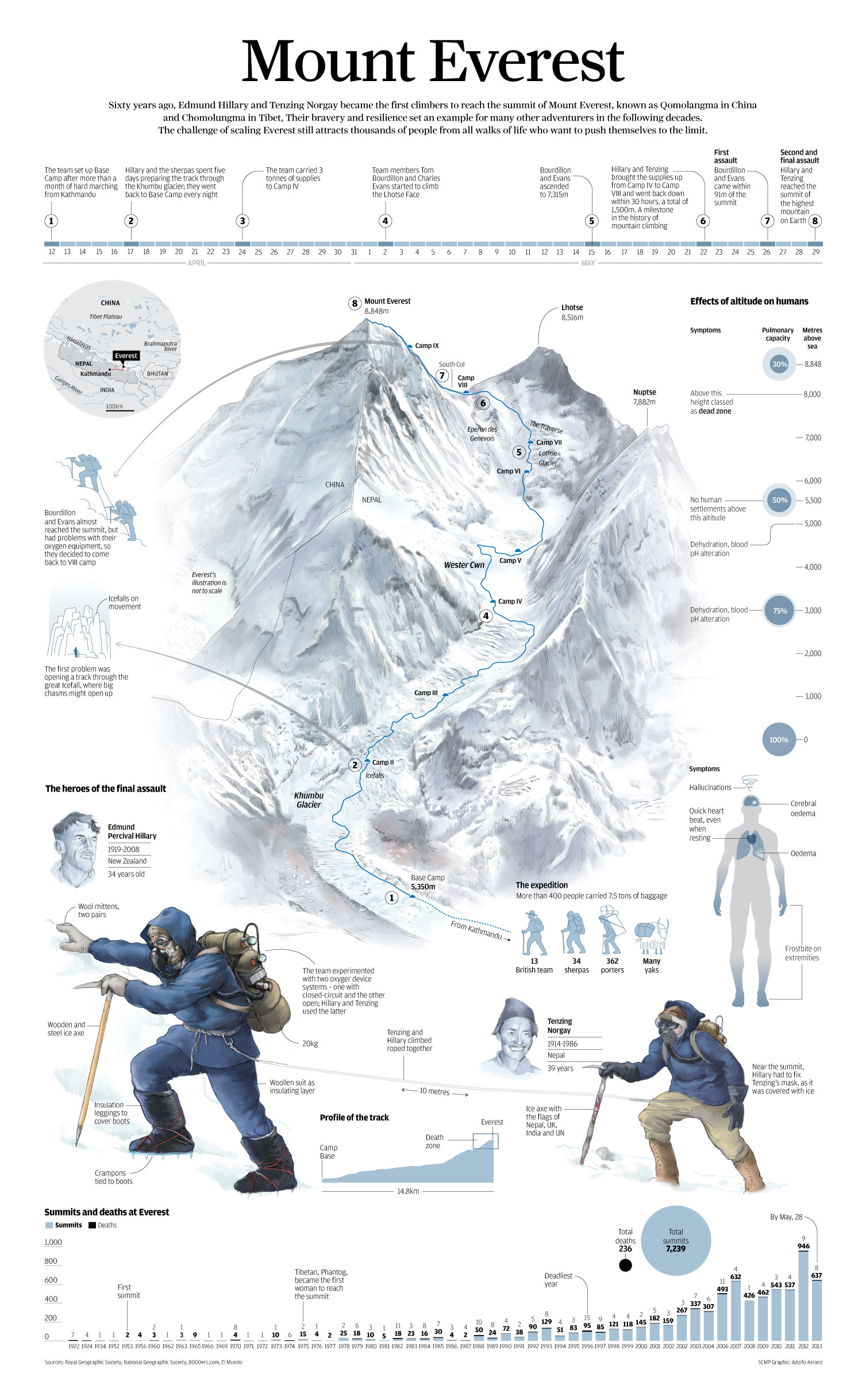
Mount Everst infographics - there are plenty of them...
I have a Pinterest page of them.

Wednesday, 22 November 2017

Mend the Mountains

 
A new campaign by the BMC targets our mountains, and is trying to raise one million to improve the nation's mountains. There's a useful video here showing the background to the campaign.

Wednesday, 15 April 2015

Ascension

Thanks to  my friend Simon Hathaway for the tipoff to this wonderful animation.
Watch it full screen.
An homage to early mountaineers, with a spot of 'Touching the Void'... and one that Year 7s will be introduced to next year...


Ascension from Ascension Le Film on Vimeo.
"Ascension"

Made by Thomas Bourdis, Martin de Coudenhove, Caroline Domergue, Colin Laubry and Florian Vecchione at Supinfocom Arles in 2013. Music by Seth Stewart.

-----------

Synopsis
In beginning of the 20th century, two climbers carry a statue of the Virgin to the top of a mountain.

-----------

Ascension is a multi award-winning graduation movie, done at Supinfocom Arles in 2013 by Thomas Bourdis, Martin de Coudenhove, Caroline Domergue, Colin Laubry and Florian Vecchione. The music has been composed by Seth Stewart.

Check out the website.

Friday, 11 July 2014

Climbing a mountain....

Just before the end of term, I was contacted by my friend Dan Raven Ellison. He's a geographer, and one of National Geographic's Emerging Explorers.
We've worked together on a few projects such as Mission:Explore, which you'll remember featured in the Big Outdoors Day, and was also the format for the Year 7's Prep book during the Lent term.
This summer, Dan is going to be involved in the StepUp Mountain Challenge
Visit the site above and you may see some familiar uniforms getting in some practice for climbing lots of stairs.

After the summer we're going to be getting involved with the challenge by climbing the height of a mountain during one of our geography lessons when we explore the idea of landscapes.


Just have to choose a mountain now... may go for my favourite one....
Here's some of 7QP getting in training...

Get involved with the hashtag #StepUpMountain

If you want to get involved, visit the site for the details:

Inspired by Daniel’s urban expedition, Ordnance Survey have created this great step mountain calculator mapping tool to help you step up to the mountain challenge and calculate the buildings or mountains you have climbed the equivalent height of:
Type in the number of steps you have climbed. This could be on your own, as a team, in an hour or over a year.
The calculator will show you on a map the name of building and mountains that you have ascended the height of.

To follow Daniel’s expedition to step up to the height of Mount Everest you can follow him on Twitter at @DanRavenEllison #StepUpMountain

He would love to hear what you are planning and have achieved!

Saturday, 8 March 2014

Cleaning up the mountain...

An interesting story on the new proposals that are facing those who wish to climb the world's highest mountain: having exerted themselves and paid the fees to reach the summit, they are going to be asked to bring down some garbage with them...

Everest has been progressively littered by those who have climbed it over the decades, sometimes with the ultimate piece of litter: themselves...

For more on Everest, check out Matt Podbury's excellent Geography Pods site for a unit on the mountain.

Wednesday, 30 October 2013

Teaching about (mountain) landscapes...

Connecting with our Adventure Landscapes unit....

My seminars are available to view on my SLIDESHARE page.


I referred to Paul Cornish’s useful diagram from the GA’s curriculum planning site, which asks questions relating to the choice of case studies.
Hopefully these move away from ‘the one in the textbook’… and are influenced by student and teacher choice and also experiences.

I used the idea from Doreen Massey’s lecture where she referred to mountains themselves as ‘migrants’ in that they were constantly moving and changing, and how maps are a surface on which millions of stories are told.

The idea of curriculum making came through, as did the idea of telling stories. Geography means 'writing the Earth' of course, and there are lots of opportunities for this to happen in familiar landscapes. I talked about teaching about mountains in the Fens, where the highest point was only 26m above sea level.

I used an extract from Robert MacFarlane's 'The Old Ways' along with 'Digimap for Schools'

There were also some ideas from Noel Jenkins on ‘grabbing’ and appropriating landscapes using Google SketchUp – which he added to with models from the SketchUp Warehouse.
I mentioned Tony Cassidy's Facebook idea with Liz Smith examples.

Dropbox folder of resources was shared with the delegates. Thanks to the fifty or so delegates who chose to come to my session...


If you would like to have access to the main written resource, drop me a line...

Wednesday, 16 October 2013

Touching the Void 1

Reading week for Year 7 meant 'Touching the Void'
We were using a Scholastic version of the book which shortened the original book, and also took out some of the bad language in the original book - when you find out what happened to Joe you'll realise why he might have said some naughty words...

We have been using some nice resources created by Miss Kyndt, supplemented with a few of my own making. I'll add a few of those shortly to the blog...

First of all, before we started to read the book, we looked at some of the vocabulary that we needed to learn. Like any subject, geography has a particular vocabulary, and so does an activity like ice climbing... It's important to take in some new words when reading any book, but also to develop your familiarity with terms...

The wonderful sheet by Miss Kyndt has this activity supported for you.


Saturday, 31 August 2013

Everest

As part of the adventure landscapes unit that we will be using with Year 7, we will be exploring a range of mountain landscapes.
Mt. Everest is the world's highest mountain, although there are other mountains which are more dangerous to climb, and which are also potentially 'higher'.

Bonus points for anyone who can identify the two mountains that I have in mind, that you could argue were 'taller' or 'higher' than Everest for different reasons....

We will draw heavily on the work of Matt Podbury who has put together a remarkable unit of work on Everest over the summer, with the help of the excellent John Parrott .


Wednesday, 17 July 2013

Everest.... "because it is there..."

I'm planning to take the Adventure Landscapes opener for Year 7s to extremes: to the roof of the world.
Students will be conquering the death zone, and exploring the awful fascination of this place...
The video for this track by 'Public Service Broadcasting' will be an opener....
Russel Tarr is a fan, which is as good a recommendation as any...

Friday, 5 July 2013

Dangerous mountains...

I'm planning to bring in / develop some element of mountains at KS3. There are a few options for this. I like the idea of juxtaposing extreme height, compared to a school which is only 28 miles from the lowest point in the British Isles. Holme Fen. Holme Fen is 2.75m below sea level...

Ely's highest point is about 39m above sea level, some way below the height of the mountains. We'll perhaps consider the height of the Octagon Tower / Lantern Tower of the cathedral, which is spectacular, and was built in the 1300s....

The Economist published a really useful resource which provides an image of the highest mountains and the risks involved.
It's taken from this article (which may disappear over time and not be available when you click...)